Surviving Leukemia with Katie Brenneman: Mindset, Hope, and Healing
Episode Overview
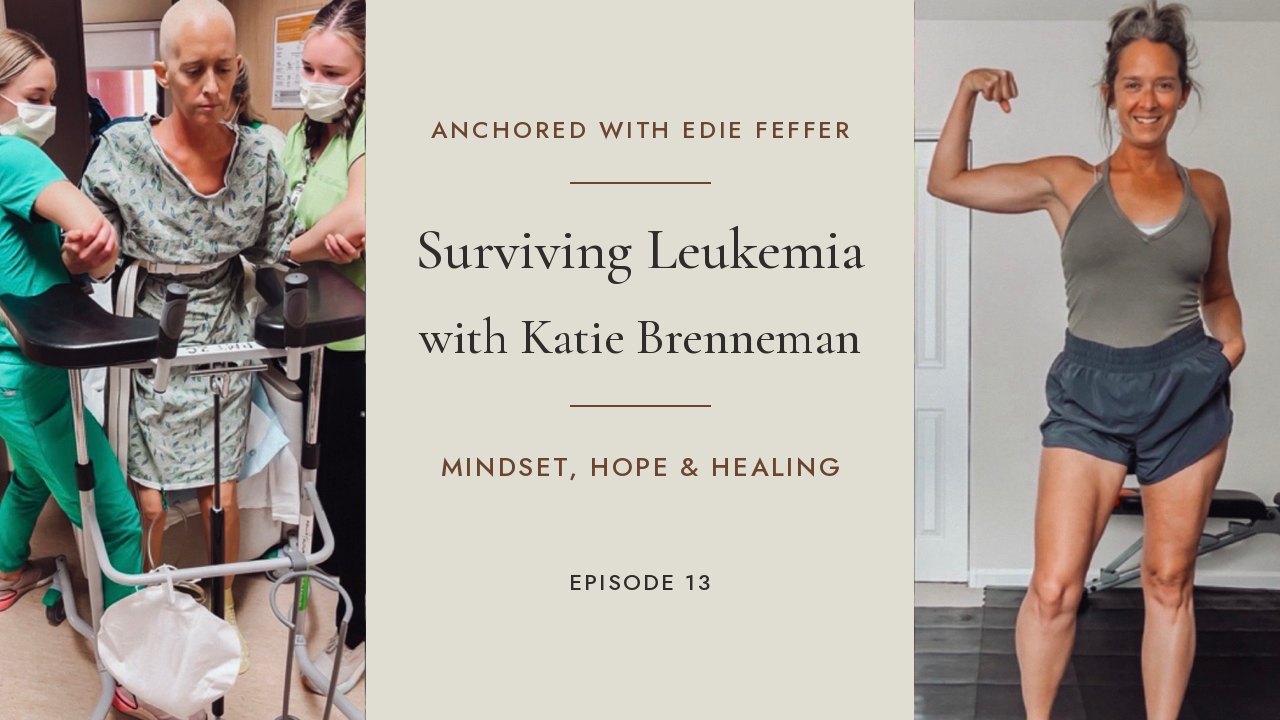
After an aggressive acute myeloid leukemia diagnosis, Katie Brenneman faced one life-threatening complication after another, months in the hospital, repeated treatments, and a stem cell transplant.
In this conversation, Katie shares the mindset practices that helped her protect her peace, hold onto hope, and partner with her body when so much was uncertain. She also opens up about the PTSD and survivor’s guilt that surfaced after treatment, how EFT supported her emotional healing, why language mattered throughout her diagnosis, and the practice of identifying three daily wins as she rebuilt her strength and independence.
Whether you are navigating a diagnosis, supporting someone you love, or moving through a difficult season, Katie’s story offers a powerful reminder of what is possible when we focus on what we can control.
Resources Mentioned in This Episode
- Everything All at Once: A Memoir by Stephanie Catudal
- The Energy Bus by Jon Gordon
- Matthew Ferry: matthewferry.com · @matthewferryquietmind
Additional Support
The book links above are affiliate links. As an Amazon Associate, I earn from qualifying purchases at no extra cost to you. Full disclosure.
Read the transcript
This transcript is lightly edited for readability.
Katie: It was on paper the worst, hardest year of my life, and the worst and hardest thing I've ever gone through in my entire life. And also it's the period of time in my life that I look back and realize I felt the most peace and the most joy and love and gratitude and all of that. It really made me realize, my big takeaway from all of it is that I am the creator of my experience regardless of my circumstances.
Edie: This is one of the most special podcast episodes that I have recorded. It is with my dear friend, Katie Brenneman, and she was my first health coach. She's had a profound impact on my own health and wellness. Sorry, I'm already getting emotional, Katie. I wasn't expecting that. But Katie is here today to share a little bit of her health journey with us, specific to leukemia and surviving one of the most challenging cases of leukemia.
And while this is a conversation around cancer, it is so much more than that. It is a conversation that will touch on self-trust, navigating uncertainty, and mindset, spirituality, maintaining faith and hope in the unknown. And it is a conversation that will inspire you if you're facing any difficult diagnosis yourself or just simply wanting to up-level your mindset.
Thank you so much, Katie, for being here today. I'd love to start just by understanding what life looked like for you before your diagnosis. What were you up to?
Katie: I am married. I have a husband, Jon, and we own a business together, and we each run our own respective sides of the business. The side of the business that I run is a long-term care financial consulting business. And you mentioned a health background — since probably 2011 I've just been really into health, fitness, nutrition, exercise. I'd been into personal development since about 2015, but in 2019 I would say it took maybe a bit more of a spiritual turn.
Edie: Can you tell me more about that, how your personal development evolved?
Katie: At a networking event that was very business related, I met a spiritual coach, and it was just something completely new to me. A lot of what she was saying was ideas and concepts that I'd never been exposed to before, but it was one of those things where you're just hearing everything at the right time in your life, and it resonates at such a deep level that you know that even though this doesn't really make a whole lot of sense, or it sounds confusing or maybe even a little scary, to be honest, it's what you need.
So I started working with her one-on-one, and it was just like going down a rabbit hole, honestly, after that. One thing led to the next, and I was immersed in it and learned a lot about myself and how life experiences going back to childhood impact who you are today.
Edie: Yes — your beliefs, your thoughts. And so you lived a healthy lifestyle, and I have to believe all of the work that you did — and you were a part of my own growth and development specific to mindset and nutrition and movement — all of that, I would imagine... or I should ask: did it help prepare you for your diagnosis and everything that you went through?
Katie: 100%. There's one particular mentor that I started working with about nine months before my diagnosis. His name is Matthew Ferry, and I still work with him today. And honestly, if I had not been doing the work with him for the nine months prior to my diagnosis, the whole journey would have been such a different experience for me, and not for the better.
Edie: We're going to get into all the different aspects of that, how you managed your mindset. But can we start by just hearing how you found out that you had leukemia? What were the symptoms? What did you do?
Katie: So it was March of 2024, about halfway through the month, and I noticed that when I was working out — I like to lift weights, and I was lifting weights at home at the time — I would be so exhausted from one set of something. The fatigue started out not as extreme, and it started getting worse over the course of about a week. But it got to the point that I'd be just laying on the floor in the room at home that we have set up as a workout room, resting in between sets and wondering, "What's going on? This is not normal." I just thought that I was fighting a cold or the flu or some kind of virus, because I wasn't really someone who got sick very often.
At about the same time I started to notice that I had lower back pain, and it started out at the end of the day only, and I figured maybe I just needed a new office chair. And over the course of that week the pain started to get worse — it wasn't just the end of the day anymore, it was all day long. I woke up with it, I went to bed with it, nonstop. Then week two, those symptoms continued to get worse, and new symptoms started to show up as well.
I started to have mouth pain at the very back of my mouth — I've had my wisdom teeth removed, but where your wisdom teeth would be. It just felt swollen and irritated and inflamed, and chewing started to become really uncomfortable. Again, I just thought maybe I had food stuck under something, but it was top, bottom, both sides, so it was a little unusual. And I have a retainer that I wear to bed, and one night when I put the retainer in, my gums just started to bleed, and I had to take it out and couldn't wear it because my gums were so swollen. So my gums started bleeding regularly — it was almost like if anything touched them it was too much and they'd bleed. They were growing over my teeth, so you could see less and less of my teeth. I had bruises.
All of this was just getting worse over the course of the second week, and my husband was starting to say, "I think we need to take you to the hospital." And I was just like, "No, I think I'm still just fighting something." It sounds crazy in hindsight that I didn't realize something was majorly wrong, but if you look up these symptoms, you can actually see that they could be a byproduct of a cold, a flu, a virus. So I just thought, "This is what's going on. I'm just fighting something."
But by the end of that second week, I couldn't walk more than five steps in the house without needing to sit down and rest and catch my breath. The mouth pain was getting really out of control. The back pain was getting really out of control. I was so physically uncomfortable all day long — I couldn't sit or sleep comfortably. I was in tears at times because the pain was so extreme. So finally one night, Jon just said, "Enough is enough. You don't have a say in this anymore. We're going to the emergency room."
He loaded me up in the car and drove me to the emergency room, and he dropped me off outside the front entrance to go park, because I couldn't walk through the parking lot myself. I went up to the front desk, and I'm just crying because I'm so physically uncomfortable. The woman asked me, "What's been going on? What are you here for?" I started describing what had been happening, and they didn't have me sit in the waiting room at all. They took me to this back room behind the front desk area, sat me down, took my vitals, started asking more questions, and instantly put me in a room with a bed.
At this point Jon's in the ER as well, so we're back in a room. And again, in hindsight — you wait at the emergency room, you know? You wait hours sometimes. So it didn't register for me that this was clearly a serious situation, because I just got rushed back to a room right away.
They set us up there, I'm laying in the bed, and they drew blood and did a urine test and told me they were checking for COVID and making sure I wasn't pregnant. And I'm still just thinking, "Man, I really hope I don't have COVID," or, "I really hope I'm not pregnant — that'd be a real bummer." Then it was pretty quick, I think within an hour, they had the blood work back. The ER doctor came in, pulled up a chair next to the bed, and sat down. I don't actually remember a whole lot about being told that I had leukemia. But he said, "I'm pretty positive you have leukemia."
It was a shock. I remember thinking to myself, "Wow, he's really good at delivering really shitty news." I held it together while he was still in there, and then he left the room, and I remember I did just burst into tears after that. But a lot of that night is pretty hazy.
Edie: I can't imagine what it would have felt like to receive that news. And did the doctor know for certain that's what it was then? I think I heard you say "I'm pretty sure" — so was he just going off the info that he had at that point?
Katie: I think what gave it away, honestly, was the gum situation — the bleeding gums, and that they were growing over my teeth. That is very common for the type of leukemia that I was diagnosed with, acute myeloid leukemia, and even then, a very specific subtype of it. But my white blood cells were, I want to say, like 70,000, and the high end of normal is 10, 11,000. My hemoglobin was really low, which is why I was so winded and so fatigued. And then my platelets were like six, and the normal range is 150 to 450, something like that. So that's why I was bleeding and had the bruises all over.
All of those levels were so low that it was truly a crisis. I could have had a health crisis that resulted in death. I think those were the signs that it was some kind of blood cancer, and then the gum situation is what made it pretty clear that it was leukemia, and specifically acute myeloid leukemia. They actually had that reference in the ER records, so they did unofficially diagnose me before I had a bone marrow biopsy to confirm the diagnosis.
Edie: Gotcha. And so now you understand how serious it is. What happened next?
Katie: That particular hospital has a sister hospital about 10, 15 minutes north of where it's located, and that hospital has a bone marrow transplant unit, which is something that's specific to blood cancer diseases typically. With acute myeloid leukemia, a lot of the time you need to have a bone marrow transplant as part of the treatment, so the ER doctor knew that's really the hospital that I needed to be at. He transferred me to that hospital that same night. They set up medical transport, and it was just taking hours and hours to show up, and it kept getting delayed. Finally it was like 3:00 in the morning and we were exhausted — we'd been there since 6:00 or 7:00 PM — and there was still no guarantee of when the medical transport was going to show up.
Jon somehow convinced the ER doctor to let him drive me. I'm pretty sure I had an IV in my arm still. The ER doctor eventually agreed — he was not keen on the idea, but he eventually agreed and said, "Drive safe, go straight there, don't speed, be very careful." They transferred me up to that hospital, and they admitted me into the regular oncology wing for the night. I just passed out — I was exhausted from everything that had gone on — and Jon went home to catch a few hours of sleep before coming back in the morning.
I woke up in the morning, and the gentleman who would eventually become my oncologist came in to meet me, introduced himself, and explained a little bit of what was going to happen. He said, "We need to basically start you on chemo right away. We can't start you on the AML treatment until we confirm that's what the diagnosis is with a bone marrow biopsy. So we'll have you do a bone marrow biopsy today and get the results back in a couple of days, but your white blood cells are so high that we need to bring them down. This is not okay." So they started me on a very generic chemo, is my understanding, to bring the white blood cell level down.
He explained to me, "We have to move really quick," because he knew that it was acute myeloid leukemia before getting the biopsy results, just from how I was presenting. He said with this type of leukemia, the leukemia cells double every 24 to 48 hours. And I didn't know at the time, until we got the biopsy results back, but 65% of the cells that my bone marrow was producing were already leukemia cells. So if I was already at 65% and they were doubling every 24 to 48 hours, it obviously was a very acute situation that needed immediate attention.
They did the bone marrow biopsy that day. They got permission to move me over into the bone marrow transplant wing before even getting the results back, because it was just so clear that I had AML. Within, I think it was two days, the biopsy results were in, the diagnosis was confirmed, and they started me on the induction chemo treatment for AML, which is a 24-hour-a-day chemo drip for seven straight days. And that's where things got weird.
Edie: And so this was over the course of a little more than two weeks. Life really did a 180.
Katie: Yeah, I went from perfectly fit and healthy — I really did not have any health issues. I went to the doctor twice a year for blood work, just preventative, but I never really got sick, never had health challenges. I was very strong, very fit, very healthy, took care of myself. And literally in two weeks, I just felt like I was truly dying.
Edie: I'm sure a lot of this is a blur, so if I ask a question you can't recall, just let me know. But when you were going through the seven-day drip chemo, do you remember what you were thinking, with all of this information thrown at you so quickly, and hearing numbers like you heard?
Katie: I honestly don't have much memory after moving into the bone marrow transplant unit. I remember the nurse who admitted me that day, and him giving Jon and me a rundown of things, and I remember getting my bone marrow biopsy, and getting a PICC line put in my arm — a catheter in my arm. After that, I honestly do not have much recollection of anything until I woke up in the ICU about 10 days later.
I remember the first morning that my oncologist came in to see me — I remember some of that day and some of the thoughts that I had. But to be honest, I guess I don't even really remember having the thoughts. It's more that I've seen the text message conversations I had with friends and what I was saying to them. So in a way, my memory of that day is more through text message conversations than me truly remembering it.
Edie: I recall our Voxer. You so calmly said that you had leukemia, and even then it wasn't a question around what the outcome would be. You just sounded so confident: "This is where I am right now. This is what I need to do." We'll continue to tell the story — but can you share why it got weird, or what unfolded next?
Katie: About two days after starting the induction round of chemo, I started to have breathing challenges. I ended up in a situation where — I might not be describing this properly — it was basically very severe acute respiratory stress, and I couldn't breathe. My lungs were filled with fluid, and they were putting me on oxygen and increasing the amount of oxygen. I have no memory of any of this. But eventually it got to a point where they needed to move me to the ICU, and they intubated me, so I ended up on a ventilator, and they sedated me. I was fighting the ventilator, which is a common response.
Having the background that I have with my profession in long-term care consulting, a lot of our clients have been on ventilators, and I knew how that went for them. I think that exacerbated my fear of being on one, because I didn't want the outcome that I saw so often with my clients. So they sedated me. I was in a coma for, I believe it was about seven days, while I was on the ventilator, until my lungs could heal enough and I could clear enough fluid to be breathing on my own again.
Edie: So scary, Katie. I'm just thinking about Jon right now too.
Katie: It's so weird, because obviously what I went through was awful, but what he went through was so awful in its own way. I've said all along I would not want to trade places. Not because I don't want him to go through physically and mentally and emotionally what I did, but I would not want to have been in the position that he was in — the spouse that just feels so helpless, so powerless, and wants to do anything they can to fix the situation, but there's really nothing that they can do.
Edie: I can imagine it would be hard to be the spouse and the caregiver. And so you were in the coma for seven days — then what happened? What was the next part of the journey?
Katie: I woke up, and they had extubated me already. I have no memory of that. I have bits and pieces of memories from when I was in the ICU. Whether they really happened or not, I have no idea — they're real to me, the memories that I have. I woke up, and they moved me back over within about a day to the bone marrow transplant unit. At this point I was through the first round of chemo — they had to finish the round while I was in the ICU; I was still receiving it.
But when I woke up in the ICU, I had lost 25 pounds in 10 days, which I didn't even know was physically possible. And I'd lost all of my strength. I literally could not even move my hand myself. So I was now in a situation where it wasn't just recovering from the chemo. I had gone into this thinking I was going to be there for a month — usually they have you do the round of chemo and stay for three weeks afterwards to monitor and make sure you're stable. So I knew I was going to be there for a month, but now I woke up in such a different situation, because I literally couldn't move.
I was just laying in a bed completely helpless. I couldn't do anything for myself. I had to have people brush my teeth and feed me, and it took three of the nursing staff to get me up to use the commode. I couldn't use my hands at all. I couldn't roll over in bed. I couldn't move a blanket myself. Nothing.
And it was so odd — I didn't even identify with having leukemia, because the ICU and the aftermath from that were so much more in your face, more prevalent on a day-to-day basis, because I needed everybody to do everything for me. I really just felt like something had happened that caused me to be in a coma, and I woke up from a coma, and I was recovering from that. I really didn't even identify with having leukemia.
Edie: And where was your mindset at that point, being completely dependent on others, having lost 25 pounds?
Katie: The first few days I think I was just completely out of it and so drugged up that I don't think I really cared much what was going on, to be honest. I don't think I had it in me to care. When I woke up in the ICU, I didn't remember why I was there in the first place. I didn't remember anything that had happened. So Jon had to actually tell me all over again that I had leukemia. And I guess my response was, "It is what it is." I truly just felt so awful that none of it mattered to me.
But you know what? I started to get a little bit better, very slowly but surely. And I think my mindset all along was solid. Like you said, you remember the Voxer voice message that I'd sent you, and when I see the text conversations that I had with friends, it was very much like: this happened. I'm not worried about it.
Edie: You literally said that in your Voxer.
Katie: I think in the beginning there was some "you don't know what you don't know." I had no clue, that first morning in the hospital when I woke up and my oncologist came to see me. I didn't get it. He told me, "This is going to be a 12-month thing of treatment and recovery before you're maybe feeling normal again." And I was just kind of like, "Yeah, yeah, yeah — okay, that's what he has to say." I didn't understand the severity of my blood work when I got to the emergency room. I didn't understand the severity of the disease that I was diagnosed with.
Part of it was my own doing — I wouldn't let him tell me anything. I told him from the start, "Do not tell me one statistic. I don't want to know. If Jon wants to know, tell him separately, but do not breathe one word of statistics or survival rates or anything like that to me. I don't want to hear it." So I was oblivious in a lot of ways, maybe a little delusional in ways. But I just really thought: I'm relatively young for this diagnosis, and I was very healthy prior to this, and I'm strong, and I'm fit, and this is just something that I'm going to go through, and I'm going to be fine.
To me, it was just never any question that I wasn't going to live, that I wasn't going to survive this. Even when I got out of the ICU, I pretty much still had that mentality. I clearly had a very big setback. Now I was going to have to get through this and learn how to do everything for myself all over again — get strong enough to be able to stand, and walk, and write my name, and feed myself, and comb my hair, and brush my teeth, and change my clothes, and shower. Lots of hurdles, right? I just never really questioned that it wasn't going to turn out okay.
Edie: And where does that belief come from? How did you learn to have faith even when you were navigating setback after setback? I love that you protected your mindset by not inviting negativity or statistics in — and I'd be curious how your doctors responded to that. But where does the belief come from? Because I think there's such a difference between false positivity — not acknowledging how you feel or working through fear — and having that certainty without understanding a timeline, truly letting go of a timeline, with so many unknowns. If someone's listening and they're trying to cultivate that for themselves, do you have any words of wisdom there?
Katie: I think that's really where the work that I did with Matthew Ferry in the nine months leading up to my diagnosis came in clutch. Matthew has a number of — I call them Matthew-isms, and they're... I shouldn't say little sayings. They are empowering contexts. They are powerful frameworks. And I really relied on those every single day, numerous times a day.
The very first one that I'll share, since you were saying it's not about toxic positivity or being in denial about your situation: he says, "What you resist will persist, and what you accept will transform." Obviously I was not happy about being in this situation. It was not enjoyable in any way, shape, or form. But it was my reality. So I just reminded myself: if I resist this, it's not going to help things. I just have to accept that this is where I'm at right now and trust that it will improve, little by little, from here.
Matthew says, "All is well." And I realized: I woke up in the ICU. That wasn't guaranteed to have happened. I woke up today. I have leukemia in my body, a very aggressive form of it, with a subtype that makes it more aggressive than normal and more resistant to treatment than normal — and despite that, my eyes opened today. I am alive. So even though I'm laying here in a bed unable to move, I'm alive. If I boil it down to that — I'm alive and I'm breathing today — all is well. It doesn't mean that I was enjoying my circumstances, but at least I was still here.
He says the breakdown is the beginning of the breakthrough, and also the breakdown is equal in magnitude to the breakthrough. So I viewed it like: okay, this is clearly the breakdown, so the breakthrough is coming. And this is such a monumentally shitty breakdown that I must have something seriously good coming my way. That was a helpful thought to be having on a regular basis.
What else? I'd read this in a book prior to meeting Matthew, a book called The Energy Bus—
Edie: Yes, I read that too.
Katie: In The Energy Bus, the author tells the story of souls up in the stars, the heavens, whatever, that are looking down on Earth and deciding what they want their next life experience to be like. And Matthew has a similar take on that, where he will say, "What if we're all just souls that are here on a vacation?" This lifetime for us, this journey in this meat suit, is one vacation that my soul has opted in to having. It looked at this from above and was like, "That looks like fun."
I remember in the early days back in the BMT unit after the ICU, Jon and I would look at each other — because he works with Matthew as well, so he knows all of these frameworks — and we would just be like, "This is a really fun vacation, I guess. Thanks, soul. Good choice on this one." But it helped me to think of it that way.
Matthew taught me to do something called the worst-case-scenario exercise. When you're feeling stressed or anxious or scared about anything, fast-forward: what is the absolute worst case scenario that could happen? And make peace with that worst case scenario. It just releases the pressure, right? In my situation, the worst case scenario was that I would die. And I thought, "Okay, if that happened, then what happens?" I'm not going to be here — it's not really going to matter to me. I'm going to be dead. It'll be awful for Jon and my family and my friends that care about me, and they'll be sad, and Jon will have a mess to clean up. But the reality of it is, if I'm not here — okay. That's not saying I wanted that to happen. I definitely didn't. But I made peace with it.
And to take it to the next level: what if the worst case scenario of death is not even the worst case scenario? I'm not a religious person. But what if my human brain is saying, "If you die, that's the worst case scenario," and really, from a soul level, maybe that's not even a bad thing? Maybe my soul would just be like, "That was crazy. That was the wildest ride. What do I want to do next?" I have no clue if that's true or not, but it was helpful for me to think about it that way, because it made me realize there are unknowns all around this situation. Even what I'm perceiving to be a bad thing — who's to say it's a bad thing? I don't truly know. And that helped me embrace whatever came that day, because it was a whirlwind. It was a lot of two steps forward and eight steps back.
Edie: I think it's amazing to see that even in a crisis, you and Jon still found humor. And looking at the worst case scenario with Matthew Ferry's approach sounds like it helped you work through fear and get to a point of acceptance, which is part of his work as well. It also makes me think of something he says: that it's always working out for me, even when it seems like it isn't. Because I would imagine it would have been hard to stay positive when you keep being presented with setbacks — but to trust that it is always working out for you, even when it seems like it isn't. First, let's let listeners know how long you were in the hospital.
Katie: I was there for 10 weeks that first go-around. Then I was finally strong enough to attempt to take care of myself, to do the main activities of daily living — I could get myself to the restroom, I could take a shower on a shower chair, I could walk around the house with a walker for very short distances. So they discharged me home at that point. I continued the remainder of my leukemia treatment outpatient, although I did have multiple hospitalizations for infections. I had a strep bug and turned septic. I had pneumonia one time and was hospitalized for that, and hospitalized for additional rounds of chemo. In total in 2024, I spent four months in the hospital.
Edie: And when you think about that saying — one thing you and I have talked about is how there were these glimmers of hope that continued to come through that would prove that thought true. Even though I remember a whiteboard in your hospital room, and constantly looking at all these numbers, or a procedure having to be delayed because you weren't healthy enough. Are there examples of the miracles that you could share?
Katie: The phrase that Matthew says is, "It's always going my way, even when it's not." There were so many examples of that, and I was always looking for evidence of it, to point it out to myself so that it strengthened my belief in it.
The first example I can remember is maybe a week or two after I got out of the ICU. I have two brothers, Mike and Thomas — Mike is older, Thomas is younger. When someone needs a bone marrow transplant as part of their treatment, the first thing the doctors will do is go to siblings and do testing to see if the siblings are a match. If they're not, they have to go out to this international database of people who have volunteered to try to be a bone marrow donor for someone in need. I didn't know at the time that the statistic was this low, but I knew the likelihood is not all that high for a sibling to be a perfect match. Now I know that it's about one out of four — a 25% chance that a sibling will be a perfect match.
My younger brother Thomas came to visit me one day in the hospital, and he said, "Hey, I've got great news. We got the test results back, and Mike and I are both perfect matches." There's a 6.25% chance of that happening. I didn't know the statistic was that low at the time — I just knew this was pretty much unheard of. And I remember thinking, "I'm going to be okay." That was when I knew someone's looking out for me. The universe has my back. I'm going to be okay.
That was one piece of evidence. Everything was still awful — I was still so sick. I also had this lung infection that I developed in the ICU when I was intubated that the doctors couldn't figure out what it even was. It wasn't responding to any medication. They were cycling through different types of antibiotics, nothing was working, and they couldn't stop it growing. They couldn't cut me open and do the tests they wanted to do to try to figure out what it was, because I wouldn't have survived them. So everything was awful. I still couldn't move. But both of my brothers were perfect matches, and so it was one piece of evidence that it's always going my way, even when it's very clearly not.
Edie: You can continue to take us through what the next phase was.
Katie: It kind of leads into another example of "it's always going my way." There was a lot of talk when I was in the hospital of me needing to go to rehab after the hospital, before I could go home, because I was so deconditioned from being in the ICU. They're not going to let you discharge home unless you can be there safely, and they didn't think I was going to be able to go home safely — I was going to need to go to rehab in between.
And there was a lot of concern about me being in rehab, because when you have blood cancer like I had, and you've gone through the treatment I'd gone through, you have no immune system. My white blood cells were nonexistent. My neutrophils, which are what help your body fight infection, were literally zero — I think they wanted them around 1,500 minimum. So I was a huge infection risk. I needed blood and platelet transfusions literally every single day, and they can't give you those at rehab. It would have been this really challenging situation of being in rehab but maybe having to transport to the hospital for transfusions daily, while being such a high infection risk.
The reason you're in a bone marrow transplant unit with what I had is because they have very heightened safety and cleanliness protocols and infection-risk-reduction protocols. I literally wasn't allowed to leave the bone marrow transplant unit until I was discharged from the hospital. I didn't get to go outside. I didn't get to go to a waiting room where I could see my relatives under the age of 18 who weren't allowed in the unit. I couldn't go anywhere. So it was a huge risk for me to be in something like rehab that doesn't have these cleanliness protocols — every time you get an infection in that state, it's life-threatening.
So it worked out that, because I had the lung infection and they needed to keep me there longer for it, I was able to rehabilitate enough in the hospital, through physical therapy and occupational therapy, that I was able to discharge straight home and skip rehab altogether. I remember viewing that as a huge win — an example of it going my way. No one wants to be in the hospital or in rehab, but honestly, the bone marrow transplant unit was the best place to be, if I had to choose. It's funny — I accidentally would call it the hotel room all the time, and Jon was like, "It's not a hotel room. It's a hospital room." But I was like, "This is like the Ritz-Carlton of hospitals." If I had to pick some place to be, that's where I would have preferred to be. It was small, I knew all the staff so well from being there so long, the level of care was incredible, and everyone was amazing. Every single doctor, nurse, therapist — everyone was such an angel. I can't imagine having been anywhere else.
Edie: We can see how the setbacks, in a way, were serving you — helping you be able to recover and rebuild your strength. And I remember you sharing that you read a book with a survivor who served as an expander.
Katie: He didn't have leukemia — he had a very rare form of lymphoma that impacted the lungs in particular. His name is Tommy Rivs, and the book is Everything All at Once. It was written by his wife. Tommy Rivs had actually been in the same hospital that I was in, the same bone marrow transplant unit, and as a result he'd had some of the same physical and occupational therapists as I had. One of them told me a little bit about him one day — this was very early on — and she said, "His wife wrote a book, and maybe that's something that would be interesting for you to read at some point."
At the time, I couldn't use my hands to read a book, or my phone, so it didn't matter. But I remembered it, and once I gained enough hand and finger dexterity back that I could use my phone and a Kindle, I downloaded the book and read it, and it was so expansive for me. I hope I don't get any of this wrong, but Tommy was an ultra-marathon runner, and he'd been in phenomenal shape. He was diagnosed with this disease and ended up — I believe he was in the ICU at the same hospital, maybe intubated as well, on a lot of machinery. He was in a coma for much, much longer than I was. His body emaciated far more than mine, which seemed hard to even fathom given the condition I was in.
And the therapist who shared his wife's book with me told me that not only did he survive blood cancer, but he went on to run the New York City Marathon, I think it was 12 months after he discharged from the hospital. And I remember — at the time I'm laying there, I can't move, and I'm like, "Oh my God, if I could just walk again." I don't like running. I don't care if I can ever run again. If I could just walk again, that would be amazing. And if he could run a full marathon 12 months after that situation, then there's hope. There's hope for me to be able to walk.
Edie: What a great expander.
Katie: It's an incredible book. I'd recommend anybody read it.
Edie: I'll put it in my queue. And can you speak to any of the other mindset practices that you implemented, or things that you did with boundaries to protect your peace while you were in the hospital?
Katie: I think it started with, like I said, when my oncologist first came to see me, telling him I'm not interested in statistics. And I know you were curious how he responded to that. He was wonderful. He totally understood. He understood that everyone's different — some people want that kind of information, and some people don't. So he was fully respectful of it, and he made sure that all of the team I was seeing — every nurse practitioner, nurse, therapist — knew that was information I didn't care for. And it was cool, because Jon liked that kind of information, and seeing how they would tailor how they interacted with each of us — they really basically did twice the work, because they had to have a conversation with me completely separate from the conversation they would have with Jon.
From the get-go, I just really wanted to focus only on the positives. And I guess where the not wanting statistics came from was a feeling that statistics are about averages — and who's to say I'm average? I'm younger than the average age that someone is when they're diagnosed with this. I'm probably healthier prior to this than the average person diagnosed with this. I probably exercise more and am in better physical shape, and I probably fuel my body better than the average person diagnosed with this — and fuel my mind. I just viewed myself as: I'm not the average, so I don't care what the statistics are, because they don't apply to me.
Coinciding with that, I was very careful with the language that I used. I will say now, "I had leukemia," but at the time, I didn't like saying "I have leukemia," because to me that was like taking ownership over something, or claiming it as my own, and I didn't feel that way. I felt like this was just a blip on my radar — a temporary thing that I was experiencing and that would be behind me soon. So I would say "I was diagnosed with leukemia" instead of "I have it." Or, on the vacation train of thought, I would say, "Leukemia's on a short vacation in my body." It was always: this is a temporary thing. This is not who I am.
I know everyone's different, and I don't want to insinuate that there's a right way or a wrong way to experience cancer. Everyone needs to figure out what feels good and empowering for them. For some people it might feel good and empowering to say, "I am fighting cancer" — and you'll see people on social media that, pardon my French, are like, "Fuck cancer." That's fine if that's what helps someone, but that didn't feel like helpful language for me. So I never viewed it as "I am fighting cancer." I viewed it as: if I have cancer in my body right now, my body is trying to tell me something. Something went wrong in my body that allowed this to develop, and my body is trying to communicate to me that it needs something different than what I was giving it. So instead of me fighting my body and fighting the cancer in my body — it's in me right now, it's a part of me — how do I heal from it? How can I partner with my body? We're on the same team, trying to heal from this thing, not fighting this thing. That was a very conscious choice that I made throughout the entire journey.
I would have conversations with my body before bed at night. I remember when I could use my phone again, I Googled what leukemia cells look like so that I could envision them, and what neutrophils look like, and white blood cells, and red blood cells — that way I had an image in my mind, because I don't have any medical background. And at night before bed, I would visualize all of the blood cells that I wanted more of growing and multiplying, and the leukemia cells getting crowded out or disappearing. And I would talk to my body. I'm not a religious person, but I called it my angels, and I would tell my angels what I wanted them to do at night inside of my body while I was sleeping. I would just give instructions: "There's this lung infection. You're going to go to that spot, and here's what you're going to do. Do your thing. I'm going to be sleeping, I'm going to be resting, I'm going to be healing, and you're going to do your part while I'm asleep tonight." That was something I did regularly throughout the treatment process. What am I forgetting? I feel like you know so much of it.
Edie: I think this is such an important part of your healing journey, because it highlights how you didn't let yourself become powerless. You still were so intentional with the language that you used toward your body, the thoughts that you were thinking, where you put your attention, and the mind-body connection. And the body chats concept is one that I've shared with clients, because that's something that we can do. I've used it for my own gut health journey as I've worked on healing SIBO. I've shared it with clients who are navigating osteoporosis — visualizing our body building bone, talking to the body. And I would love if you could just share what that is like. There's no right way to talk to your body, but how do you do that? What does it do for you?
Katie: It's interesting to ask me what it's like, because it's nothing formal. It's literally like I'm just talking to my friend. There's no right way or wrong way to do it. I'm just like, "Hey, body. Here's what's happening. Here's what we're going to do."
Another example of it was after my stem cell transplant. You have to be really careful in the sun for six to 12 months afterwards, and I love being out in the sun — that was just devastating for me to learn. So I was really eager to be able to get back into sunlight. It was February, about six months after my transplant, and the weather was starting to warm up — it's nice in Phoenix, Arizona all winter long — and it feels really good to go lay out in the sun for a little bit. And I couldn't even be outside in 75-degree weather for five minutes before my skin would start to feel prickly and itchy and uncomfortable. I was just so sad that I was not able to be out enjoying the warm, healing sunshine on my skin.
Finally one day I was reminded, "Why don't you have a body chat?" And I was like, "Oh yeah — why did I forget about that?" So that night I had a chat with my body: "Look, here's what we're going to do." Thomas — my brother, who ended up being my stem cell donor — I was like, "Thomas, your cells and my cells are going to be on the same team. We're going to work together." There's nothing formal about it. But the crazy thing was, literally right after I had that body chat — I'd had six months of being uncomfortable in 70-degree weather — it was like 87 degrees out the next day, and I went outside and laid out for one minute on each side on a lounge chair in my backyard, and I did not have any discomfort. Every day for a week I did a minute per side, and the following week two minutes per side, and every week I increased it by a minute, and I never had that issue ever again.
Who knows? I don't know what caused it. It might have been completely coincidental. But that goes back to one of the other empowering things that Matthew taught me, which is: if you're going to make things up, you might as well make things up that feel good. The reality is, most of what we tell ourselves is a story. I had no clue if I was going to live or die. I had no clue about so many things throughout the process. So what's the empowering perspective? If I don't know whether this perspective is true or that perspective is true, this story or that story, I may as well focus on the story that feels good — that feels better to think and believe and tell myself every day. Because what difference does it make? If I don't know one way or the other, and this one over here is going to make me feel like shit, then let's focus on the one that has the opposite effect.
It's empowering to think that you're playing an active role in your healing, when you're in a situation where you feel like there's so little that you can control — and literally at the time, I couldn't even move, so there was really so little that I could do. I was just laying there with my thoughts all day. Luckily I had a lot of great friends and family coming to visit me and staying with me in the hospital, so I was surrounded by humor and love and joy. But you hone in on what you can control, and one of the few things that you can control is your thoughts — how you frame your circumstances, the lens through which you experience your circumstances.
Edie: And I think what stands out to me is, one, you didn't take on the identity of the diagnosis. I can relate to what you shared around not wanting to say "I have" — I have applied that same train of thought with parts of my own health history. It's not mine to keep. And then also the concept of working with your body, not against it — and you can see that you were able to find so much evidence of how that's true, how you were on the same team. And I like the headspace that you were in with limiting the amount of information that was coming through, to keep you in a state of expectant energy and hope and possibility. And you've used statistics to your advantage, even when they've been frightening. I'm thinking of a conversation you had with someone you were connected with through LLS. And I think it would be good for listeners to know just how rare the form of leukemia that you had is.
Katie: I looked this up after my stem cell transplant, when I was pretty removed from it — several months out anyway. To this day I still don't know what the survival statistics are for what I had. I don't know what survival rates are for stem cell transplants. I don't want to know any of that information, so I don't go seeking it out. But I did Google what the likelihood is of an adult being diagnosed with AML, and it's something like 0.0043%.
And I thought, "Huh." It would be really easy to be like, "Why me? That is such a rarity — how did this happen to me of all people?" Or I could look at it like: statistics go both ways. If something unwanted happened to me that's that rare, then something wanted that's that rare has the same possibility of occurring for me too. Especially when the number's as low as 0.0043%, it just helped me reframe things: literally anything is possible. If there was a 0.0043% chance of me being diagnosed with AML, and I was, then I don't care how low the likelihood is that you tell me of anything else happening that I want in my life — it's possible, because this happened to me. And I've just viewed things that way ever since.
I have a note on my phone that I try to read every morning before I start my day that refers to that. It refers to: one of my oncologists in the hospital told me that 95% of people wouldn't have survived what I did in the ICU, so I have that statistic down. I have down that there was only a 6.25% chance that both of my brothers would be perfect stem cell transplant matches for me. And — we haven't talked about this yet, but I ended up going from 10% leukemia cells in my body to no evidence of disease in a span of two weeks after treatment had ended, out of nowhere, and my doctors aren't positive how that happened. So I have that down too. And I follow it up with: the statistical likelihood of something doesn't matter. I am a powerful creator and a miracle. Anything is possible. I try to read that every single day, just to remember and drill it home.
Edie: Such a good practice, and such good evidence of how powerful you are and how miraculous the body is. And one other piece of evidence that I'm remembering was your trip to MD Anderson. Where does that fall? Have we gotten to that part of the story?
Katie: We just didn't get that far. I had to do numerous rounds of chemo even after discharging home from the hospital after that first 10 weeks. The first round of chemo — I'd been at 65, 70% leukemia blasts, and the induction round got me down to like 10 to 15% when they did another bone marrow biopsy. So I did another round of chemo, and my blasts actually went up, to 15 to 20%. I was still so frail that they weren't able to give me as strong of a chemo treatment as they wanted to, and the leukemia was aggressive, and it grew despite my being on chemo. By the time we got those results back, I'd gotten strength back and was a little bit better, and they were able to do a stronger dose for the next round. That got me back down to 10 to 15% again.
But I was hospitalized because I had pneumonia, and they had to end that round of chemo early, because they were worried it would kill me if I continued the treatment while I had pneumonia. They did a biopsy and said, "You're still at 10% blasts, and you need to be at 5% or less in order to have a stem cell transplant." If you have more disease than that, it's not likely to be successful.
At that point, it felt to me like my doctors didn't know what to do with me anymore. They didn't have a solution. Nothing was working. Every round of chemo that I did almost killed me — I had the acute respiratory stress, I had strep and turned septic, I got pneumonia — all because the chemo was suppressing my immune system so much, destroying my white blood cells and neutrophils. So they said, "This isn't working. We think you need to go to MD Anderson in Houston" — which is like the cancer hospital of the US, the mecca. They do so much research, they do clinical trials. They said, "There's a clinical trial for a targeted therapy for the mutation that you have of AML. It's pretty late-stage trials, and it's had really good success rates, and we think you need to go there and see if you're a fit for it."
So Jon and I flew to Houston and met with the leukemia doctor there who was heading up the clinical trial, and he said, "You're a perfect fit for this — here's how it works and the success that we've seen." This was a Thursday. He said, "We want to do some tests the next two days, give you transfusions on Saturday if you need them for blood and platelets, admit you on Sunday, and start treatment on Monday." So it was a whirlwind. Later that day I went and got a bone marrow biopsy, because they couldn't use a different hospital's for their own clinical trial — even though I'd had one two weeks prior, they said, "We have to do our own" — and they were going to do a bunch of other tests.
Then on Saturday, Jon and I were sitting in their outpatient clinic waiting for me to go to a blood transfusion, and we got a phone call from the head nurse of the clinical trial, and she said, "You're no longer eligible for the trial." And our hearts just dropped. Why are you leading with this? And she goes, "Because there's no evidence of disease in your biopsy. You're at less than 1% leukemia blasts" — which I guess is as precise as the testing gets. They say less than 1% because they can't ever say there's literally no disease; that's just as sensitive as the technology gets.
Jon and I are in shock. We're just like, "What? What do we do now? What do you mean?" It was so surreal — it was almost like I needed someone to now convince me that I didn't have cancer in my body anymore. They said, "We're going to have the doctor call you, because this is obviously very unusual and confusing." The doctor called us later that day, and he just said, "Go home. Get another biopsy there — I'm sure they'll want to confirm this is accurate. But go home, and if you can go to transplant inside of the next two weeks, do it. If you can't get to transplant that quickly, then you'll need to do another round of chemo to keep the disease low enough to go to transplant safely."
So we rushed home, and the hospital that I was at did their own biopsy, and it also came back at less than 1% leukemia blasts. And luckily they'd already solidified at that point that my younger brother was going to be my donor between the two brother choices, and all of the testing was done — he was primed and ready to go. So we were able to make everything happen quickly enough that I could go to transplant in the next two weeks.
Edie: Amazing. And nothing that could be explained, right?
Katie: The leukemia doctor from Houston said his best guess was that when I did chemo, I would have two or three different treatments combined, and his theory was that maybe one of the treatments had a tailing effect — that even though I'd ended the treatment, it was still working inside of my body. But there's no evidence to support that; it was just his best theory. My oncologist at home said that he'd only ever seen it happen one other time in his entire career, other than me. So it's not common. Whatever caused it, I don't know, and I don't really care. But again, it was just empowering to think: science doesn't really have an answer for this. So what if all of the things that I was doing, and all of the people that were praying for me and sending me good energy and healing thoughts and healing vibes — I believe in the power of all of that, and to me that was evidence that all of it was working.
Edie: And so after you do the transplant, then where are we in terms of healing and recovery? What does life look like after the transplant?
Katie: The transplant's a pretty mind-blowing thing. I find it hard to wrap my mind around that it's even medically possible. For some context for listeners: they give you an extremely strong chemo treatment the week before your transplant — I believe it's the strongest chemo of any that they gave me throughout the entire process — because they basically need to eliminate your entire immune system so that the transplant takes. You can't put foreign stem cells into your body, because your immune system will fight them, and they will realize they're in a foreign environment and fight your body. So they literally eliminate your immune system. Your body's ability to produce its own blood cells is destroyed.
They give you this chemo to accomplish that, and then they do the stem cell transplant, which for the recipient is basically just like a blood transfusion — it takes an hour, very uneventful. And then you wait, and you're hospitalized for about a month total in most cases. They need to make sure the new stem cells engraft, is what it's called — where they take hold and start reproducing and creating new blood cells again. You usually have pretty unpleasant side effects from the chemo that's given before transplant, which I did, and I needed to be hospitalized for those side effects. So it was a really taxing physical experience.
When you go home, you need to be extremely cautious for 100 days minimum — 100 days is the first milestone they want to get to. You have no immune system; your immune system is literally starting over fresh from scratch. Anything that you've ever had immunity to before is gone. On top of that, they're giving you immunosuppressant medication, because they need to make sure your immune system doesn't flare up and cause problems with the donor cells — you stay on that for usually six to 12 months. So your immune system's being suppressed by medication while it's also still trying to rebuild from scratch, and you can't be around a lot of people.
For a long time there, I was pretty much confined to home or the outpatient clinic, and that was really it. And I couldn't even really be outdoors, because I would have these physical reactions to being out in the sun — and if you get sunburnt or have too extreme of a reaction to the sun, it can cause something called graft-versus-host disease to flare up, which can kill you. So it's serious. You have all these protocols you have to follow at home. I wasn't allowed to eat raw fruit or vegetables for a really long time, because there was too much concern about bacteria on them — everything had to be cooked very thoroughly. You couldn't really eat leftovers. Just the extent to which you're washing your hands and showering and cleaning everything is next level. So life was pretty weird for several months there, until I started to stabilize and had enough successful outpatient visits where the doctors and nurses were saying, "You're doing well, you're recovering, and we can start to give you some of your life back, honestly."
Edie: When we think about the timeline, Katie, of going from the day you were in the ER and received the AML diagnosis to going through transplant — how long of a journey was that?
Katie: It was about six months. I was admitted to the hospital towards the end of March, and I went home from the hospital from transplant around the middle of September.
Edie: And is there a point that life started to feel normal again?
Katie: I would say probably around the holidays — probably around the 100-day mark. And "normal" is so hard to gauge, because there are ways that even today, almost two years post-transplant, I still don't feel normal. I don't feel the same way that I did before all of this. Everything happened in stages. And especially because things were so awful for me for so long — having no independence, not being able to do anything for myself — by the time I got to transplant, the staff was telling me, "You're going to breeze through this compared to the average AML patient going through a stem cell transplant, because you've already been through everything else, and that in some ways is so much worse." It's all relative. There were aspects of the physical recovery from the transplant that were really hard, but at least I could roll over in bed and move my hand and stand up and walk and take care of myself. Even though there were things I still couldn't do, at least I had that. The whole experience really reframed life and the things that I took for granted before all of this.
I would say probably about December, January was when I started getting some little freedoms back. For 100 days you pretty much have to have a 24/7 caregiver — literally someone with you 24 hours a day. So for a while, I was allowed to be left alone for an hour by myself, or two hours, and I would joke, "I'm graduating — I don't need a babysitter anymore." At some point I was able to start driving short distances, within a five-minute drive from my house. Things like that just started to come back little by little. I could go eat at a restaurant on a patio — a not-crowded patio. Jon and I went on our first date — I think it was our anniversary, at the end of November — the first date we'd had since all of this started in March. Eight months. That was a little win. And we took a two-week trip to California, to the beach, between Christmas and New Year's — the first time I got to get away, get a change of scenery, in almost a year. Things like that started to happen that made life feel a little more normal, even though it was still far from normal.
Edie: I think just listening to you talk highlights how much I take for granted right now — all these little freedoms. I'd love to spend some time talking about what life has been like once you were in remission, from a mental health perspective, if you're comfortable going there. Because I feel like that's a side of the journey that isn't often discussed openly, and I think it could help others perhaps feel less alone. In some of our conversations, I know there's gratitude for a social worker who may have given you a heads-up around some parts of this phase of the healing journey. So anything you're willing to share there — what you didn't see coming, what you didn't expect, what you struggled with.
Katie: It was maybe a month after I got out of the ICU — there's a social worker specific to the bone marrow transplant unit, and she was amazing. She came to see me one day to check in and say hi and talk, and she gave me a heads-up that sometimes when people have been in the ICU, they end up experiencing PTSD, and sometimes it doesn't surface until months and months later — so just to be aware that was something that could happen. And I was so grateful that she had that conversation with me and that I remembered it.
Because it was probably around November, December, January that I started realizing that things were just off, and I didn't know what it was. I couldn't put my finger on it. It really wasn't until later in January or February that I started to connect the dots and thought, "Huh. I wonder if I'm experiencing PTSD."
The way that it presented for me was a variety of ways. I would wake up in the morning, and the second my eyes opened — some days, not every day — I would feel anxious. And it wasn't mental anxiety; it was more like anxiety in my body. It was confusing, because my eyes literally just opened — nothing has even happened yet today. How can I possibly be feeling anxious about something? There were a lot of mornings that I would wake up, and the second my eyes opened, I would just be like, "Ugh, I wish it was nighttime. I wish it was time to go to bed right now," because I just didn't want to get up and start my day. Honestly, it was so hard to drag myself out of bed to start my day.
I was not finding joy in the things that I used to find joy in. And it was also hard because that was when I wasn't really able to be outdoors in the sun, and that was something that brought me so much joy in the past — I loved laying out in the sun for 20 minutes in the morning and going for walks, and I just really couldn't do that.
I would feel incredibly triggered by things that I knew it was not reasonable to feel this triggered by. It felt like a very excessive, dramatic reaction to whatever happened, and that was very unlike me. I was very aware that it was happening in the moment — I just felt like I had no control over my reaction, and I knew that wasn't normal for me. I felt very overwhelmed and stressed out very easily. The cognitive abilities were just not there. If I had to put a lot of thought and energy and attention onto something, I would feel stressed out very easily, and it could be literally paralyzing — "I'm so overwhelmed by this that I just feel like I can't do anything." So it was hard to take action on things. It could be something as simple as trying to do a chore around the house.
So I realized I needed to seek help. And it was really hard, Edie, because you're thinking, as you're going through this: I lived. I should be finding joy in everything, and I should be jumping out of bed in the morning excited that I'm alive and here for another day. So there was this element of, "What's wrong with me, that I'm feeling these feelings and having these thoughts?" And there was also this element of survivor's guilt. I never experienced survivor's guilt like some people do, where I felt guilty that I lived. But I experienced it in that I recognized how many people would give anything to trade places with me right now — or their loved ones. The person didn't survive, and their loved ones are like, "I would give anything for my loved one to have survived this." And I'm over here being selfish, thinking these things and feeling these ways.
So it was a really confusing experience to be having, and it's one that I don't think gets talked about enough. In some ways, life after leukemia, for those several months there, felt harder than life with it — which is crazy to think about when I reflect back on everything that physically went on. But that's truly how it felt.
Luckily, I know you, and you reminded me that EFT — tapping — can be such a powerful tool for working through feelings and thoughts and experiences like this. Especially because talk therapy just didn't resonate with me. I very much was like, "This isn't a conscious thing. I don't feel bothered by what happened consciously. I don't struggle to talk about it. I don't get upset talking about it." So I just felt like, what good is talking about it to someone going to do? How is that really going to help me, when it felt so much more like it was some kind of trauma stuck in my body? I thought that might have been why I was waking up first thing in the morning feeling the anxiety in my body when nothing had happened yet. Nothing had happened that second — but my God, what had my body been through for six to nine months, and was still going through, honestly, healing from all of the treatment? It's a lot to process.
Edie: Yeah. And the beautiful thing about EFT — which stands for Emotional Freedom Techniques, also known as tapping — is that it is body-led. What was the EFT experience like for you? How did it help, or what surprised you about it?
Katie: It was life-changing. The very first session — honestly, after one session, I felt astronomically better. It felt like a huge weight just released from my body. It only took three sessions total, and I had experienced, I believe, complete relief from what I was struggling with.
I think what was surprising was how quickly it worked for me, and how little we dwelled on what happened. It wasn't a situation where we sat there and talked for an hour about all of the traumatic things that had occurred. It was more about pulling out a few select memories that came to the surface first — the easiest-to-recall things that were triggering — and crafting the language that was used in the tapping session around my specific experience, even some of the language that I was using, the way that I worded the memories. And that was the extent of the conversation that needed to be had about what happened. It was like: here's what happened, briefly; I know enough now to conduct an effective tapping session. And then we tapped through it, and then there was relief, and it was just about moving forward instead of living in the past.
Edie: Yes. You were able to identify a specific event and the specific sensory aspects — what you saw, what you heard, perhaps what you tasted, what you smelled, thoughts unique to that one event — and tapped through those. I think that is one of the benefits for anyone who's struggling with PTSD or anxiety or depression: being able to work with a clinical practitioner one-on-one can be so powerful, because it isn't a general tapping script where you're addressing things at the surface level. To Katie's point, it was using her language, her thoughts. I'm so glad you were able to find relief versus sitting in that difficult space.
Katie: It gave me my life back, honestly, which was huge — because I already felt like I got a second chance at life. So there was anger there, because it was like: man, I lived, I survived this, and now this? This is what I'm left with? I have to live life feeling like this? So truly, it changed my life.
Edie: There's so much that we could explore there, and I know we're almost at time. But I think that highlights how even if you have a really powerful mindset, and even if you have gratitude for your life and the people that are in it, and you have strong spirituality, connection to your body, all of that — you can still have circumstances where it isn't possible to think or logic your way out of them. And that is where EFT really shines, because it isn't something that you have to logic your way through, and it's also not something where you have to live through every single detail to get to the root of what's causing the emotion.
Katie: I think you hit the nail on the head with the logic. I was trying to logic my way out of my feelings and my thoughts. And also, with certain ICU memories from being in the coma — at times they lower the sedation and try to bring you out of the coma — I don't know if these memories are real or not. I was told it doesn't matter if they actually happened; they're real to you in your mind. So there were things that I could try to logically explain away, but my body didn't care, right? So it was really powerful.
Edie: Thanks for speaking to that. And when we've talked about this, I've heard you say how even though that was one of your most challenging years, it was also one of the most joy-filled?
Katie: Yeah — and even as I say that out loud, I'm like, "Is that right? Are you going to look at me like I'm crazy?" When you go through something like that, your world gets really small really quick. I was confined to what, like a 15-by-15-foot room for months on end, and I was surrounded by so much love. And luckily, my friends and my family pretty much just treated me like me through it all. We use a lot of humor in our day-to-day life, and they didn't let my circumstances impact that. So there were so many laughs. I have so many amazing memories from the hospital, with friends and family and nurses and doctors and therapists and everyone.
So yeah — it was on paper the worst, hardest year of my life, and the worst and hardest thing I've ever gone through in my entire life. And also it's the period of time in my life that I look back and realize I felt the most peace and the most joy and love and gratitude and all of that. It really made me realize — my big takeaway from all of it is that I am the creator of my experience regardless of my circumstances.
Edie: So powerful, Katie. What would you want to leave listeners with? Is there anything that we haven't hit on yet, anything you'd want anyone to know?
Katie: There's so much — it's hard to even remember all of it. But I think what it really comes down to is that we can't control what happens to us in life. Life can change very drastically on a dime, and all we can really control is the context through which we experience it. Maybe someone isn't dealing with leukemia or cancer or anything health-related, even — but we all experience challenges and circumstances in our life that are less than ideal, at numerous points. And just because it's one of those times doesn't mean that you can't also be experiencing the good things in life.
Edie: Such a good perspective. It reminds me of one of our conversations around, "Why am I not doing some of the things I was doing to get me through that, now?"
Katie: It was about the body talks — when I was struggling to be out in the sun. And Joanne reminded me: you played an active role in your healing before; why don't you play an active role in this now? She's the one who reminded me, "Why don't you have a body talk tonight?" And I did, and then went out in the sun the next day and had that completely different experience than I'd been having for months on end.
Edie: The only other thing — I know we don't have a boatload of time to cover it right now — is what your recovery looked like from a physical perspective. We touched on it from the mental health perspective, but you were skin and bones, had to learn how to walk. You strength trained regularly before this, and so you went back to a beginner's starting point — lifting how many pounds?
Katie: Body weight.
Edie: Holding onto a walker.
Katie: Trying to do squats where I could only go down two inches.
Edie: To now — just having been interviewed with your health coach on her podcast for your strength gains, muscle gains, body composition. I think that's such an important part of a healing journey too, especially when we're thinking about everything we've talked about specific to bone health, hormone health, nutrition. That could be its own podcast in and of itself, but if you have any words of wisdom or thoughts you'd like to share there, perhaps that's where we start to close.
Katie: I was someone who really liked fitness and nutrition before all of this, but it really highlighted for me how important it is — because if I hadn't taken as good of care of myself as I did before leukemia, statistically speaking, I might not be here today. It's not about doing it for aesthetic purposes. Of course people want to look and feel good in their clothes, but it's really more about health for me now than it was before. Before, it was much more aesthetically driven. Now it's about hormone health and balancing, and bone health. All of the chemo put me into menopause overnight, and when I did a DEXA scan last fall, it told me that my body was in a state of osteoporosis. Notice my language.
Edie: Yes — "was."
Katie: "Was in a state of," not "I have it." So I'm still practicing. It takes intentional thought, but I'm still trying to practice that same mentality around the language that I use around it. I don't have osteoporosis. This is a temporary state that my body is in, and I am actively healing from it, and I am fueling my body and moving my body and supplementing my body and relaxing my body and de-stressing my body and sleeping — all of the ways that research shows support healing from these things.
Edie: Is there anything I missed? Anything you want to add in?
Katie: I think the only other thing that you and I have been talking about recently is how it can be the tiniest little things that just compound. It can feel really overwhelming when you have a long way to go. When I couldn't even move my hand, I couldn't fathom ever walking again, or lifting weights again, or going for a walk. But every day I just did what I could control and focused on three wins. When my best friend stayed in the hospital with me for a week right after I got out of the ICU, she started this, where she said, "Every day you're going to come up with three wins for the day, at the end of the day." And she would ask me every night, "What were the three wins for today?" And I'd have to come up with something, even if it was: I took eight sips of water and ate four bites of food. You start where you are, and you do what you can, and let it build from there.
So body weight exercises, like you were saying I was doing when I got home, turned into two-pound weights, and three-pound weights, and five, and seven, and ten. And I could only walk for five minutes when I first got home from my transplant, and I would build my way up until I could go for longer periods of time. So it's consistency over intensity, I guess.
Edie: Such a good strategy to protect your mindset, too — to keep you focused on your improvements with the three wins per day. And a good reminder about patience and trusting the process, and not focusing on a timeline, not using that as the measure for your progress. All great tips. Well, thank you so much for being here.
Katie: Thank you for having me.
Edie: And for listeners, we will link lots of resources for you in the show notes, and perhaps there will be a part two.
Edie: If you enjoyed this episode, please do me a favor and rate it. Your reviews will help me help more people. And if you'd like my support in your health journey, you can head to my website at ediefeffer.com, where you can check out the different ways that we can work together. You can also come hang out with me on Instagram — I'm @ediefeffer.